Sumo Wrestling Rules, Scoring, and Weight Classes
My first afternoon inside Tokyo's Ryogoku Kokugikan started with the heavy aroma of bintsuke pomade drifting past the ticket turnstiles and into the upper balcony. Down on the circular clay mound, two men weighing well over 300 pounds each crashed into one another with a wet, bone-jarring thud that echoed off the high rafters. For anyone watching their first bout, the fundamental rules of sumo wrestling seem wonderfully brief: push the other guy out of the ring or force him to touch the dirt with anything besides his feet.
Yet spend two hours watching an afternoon tournament block and you quickly realize there is a maze of ancient protocol, bizarre technicalities, and physical grit operating beneath that simple objective. Between judging disputes, sixty-second ring rituals, and explosive eight-second collisions, understanding how this sport functions transforms it from a curious cultural spectacle into one of the most intense tactical combat sports on earth.
Book your sumo wrestling kyoto experience:
What Are the Rules of Sumo Wrestling in the Ring?
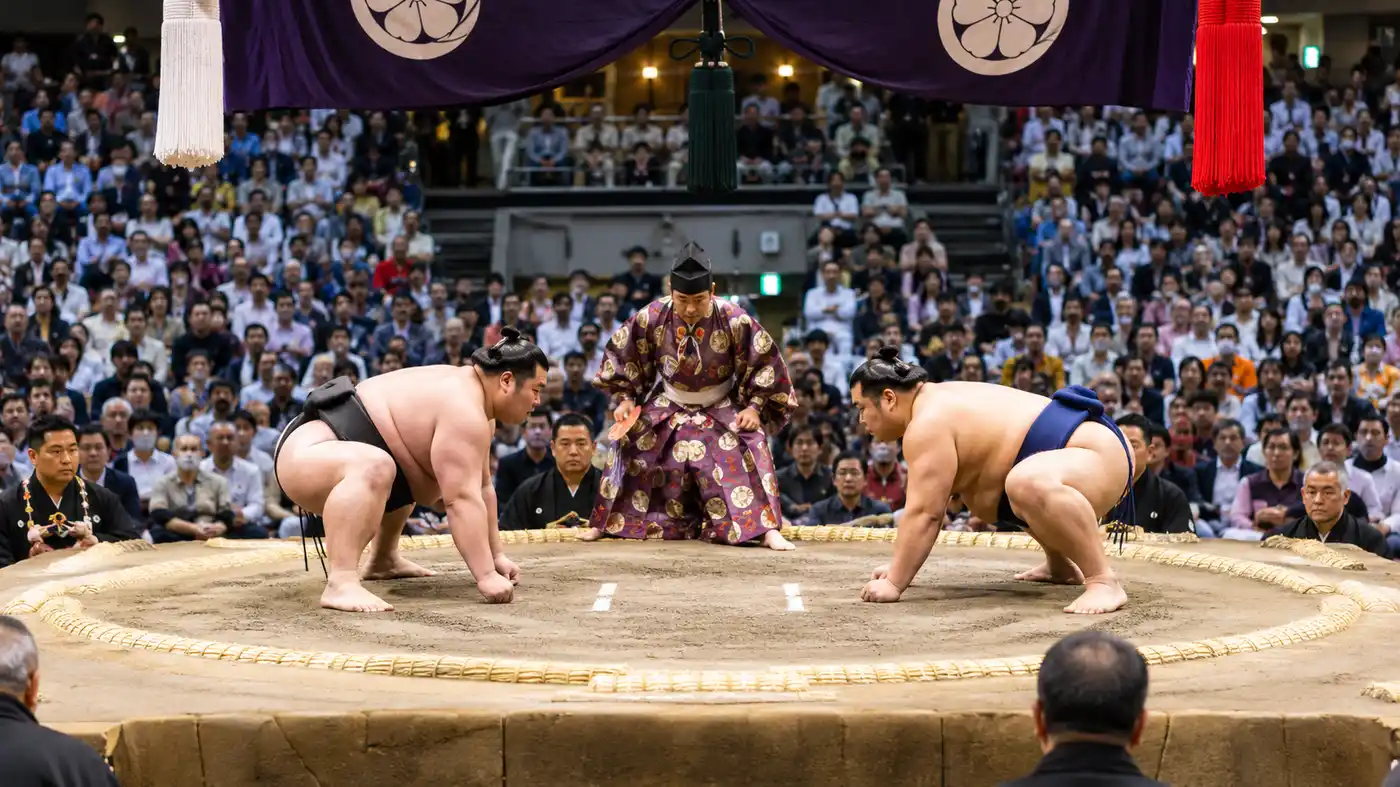
The field of combat is called a dohyo. It is an elevated square mound made of packed clay, roughly 57 centimeters high, topped with a circle measuring 4.55 meters across. That boundary is framed by 20 half-buried straw rice bales known as tawara. Once the referee gives the start signal, what is the goal of sumo wrestling? Simply put, you must either drive your opponent outside that circle of straw or make any part of his body - from a knuckle to a stray knee or the crown of his head - graze the clay floor.
A wrestler who steps on the straw is still in play, provided his foot does not cross over the outer edge onto the bare dirt outside. You will often see rikishi balance on their tiptoes along the straw lip like tightrope walkers, desperately twisting their bodies to whip an attacker down before their own heels touch the ground. If you step outside the boundary rope, you lose immediately.
Note: Touching the ground outside the ring counts as a loss even if the competitor never touched the clay surface inside. Falling backward onto the soft spectator cushions instantly ends the bout.
Matches can also end through disqualification or forfeit. If a wrestler's mawashi - the thick silk loincloth wrapped tightly around his waist and groin - completely comes undone during combat, he suffers an immediate loss by disqualification called fujoki. It sounds funny until you realize it has actually happened during official bouts, though referees inspect the wrappings thoroughly beforehand to avoid an accidental wardrobe disaster on national television.
There are also clear restrictions on how physical contact can be made. Open-handed slaps to the chest and cheeks are completely legal, and they land with shocking force. Punching with a closed fist, however, is strictly forbidden. The referee will wave off the contest and award an immediate defeat if someone resorts to bar-room brawling tactics.
- Closed fists: striking an opponent with a clenched fist brings an immediate foul.
- Hair grabbing: pulling the opponent's traditional mage topknot will trigger an instant loss via disqualification.
- Throat choking: pressing directly into the windpipe with bent fingers is banned, though open-palm thrusts to the neck are allowed.
- Chest kicks: direct kicks to the ribs, chest, or stomach are banned, though sweeping an ankle or tripping with the leg is fully permitted.
The Initial Charge and Sumo Wrestling Stance
Before any grappling takes place, spectators sit through minutes of psychological warfare. The wrestlers squat, stomp their feet in the shiko ritual to drive away evil spirits, rinse their mouths with Chikara-mizu (strength water), and toss handfuls of coarse salt across the ring. This sequence is not just theater. It allows competitors to regulate their adrenaline and study each other's body language.
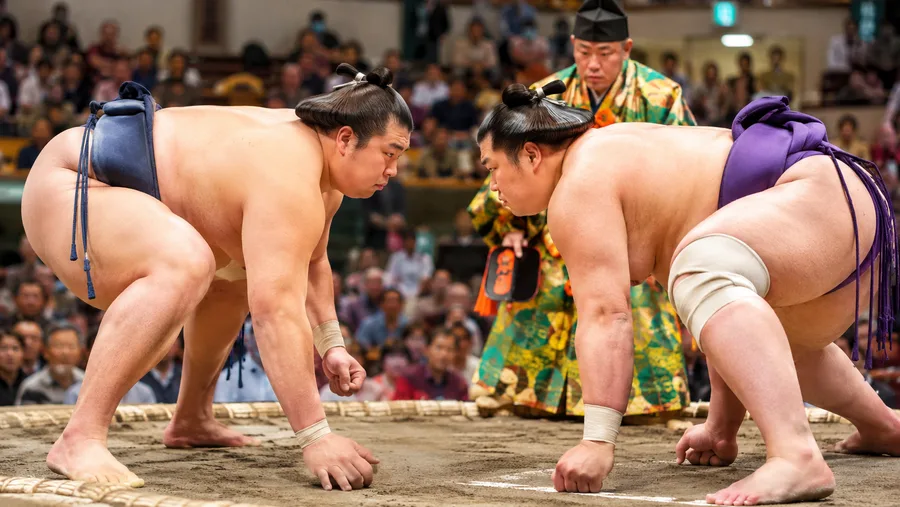
When the bout is finally ready to begin, both rikishi sink down into the deep sumo wrestling stance known as the kamae. They crouch low, chest over knees, glaring directly into the eyes of their rival. To start a match, both competitors must place both fists on the clay surface behind the white starting lines (shikiri-sen). How does sumo wrestling work at this exact second? It relies on mutual consent rather than a referee's whistle. Both men must launch themselves forward at the exact same split-second.
The resulting collision is called the tachi-ai. It is arguably the most violent initial impact in professional sports, with combined forces easily exceeding 700 pounds of mass accelerating into each other. If one man charges before both competitors have their knuckles down, the referee halts the action with a shout of "matta" - a false start. The wrestlers must return to their corners, reset their focus, and perform the pre-match squat all over again.
Pro tip: Arrive at the tournament venue around 1:30 PM to catch the lower-division matches; the arena is mostly empty, letting you sit close enough to hear the loud skin-on-skin smack of the tachi-ai.
Occasionally, a wrestler will use a controversial tactic called the henka right at the tachi-ai. Instead of meeting the charge head-on, he sidesteps at the last millisecond, letting his rival's momentum carry him tumbling uselessly out of the ring. While technically permitted within the rules to sumo wrestling, the crowd usually boos the victor loudly because it dodges the honest test of physical strength expected in professional competition.
Are There Weight Classes in Sumo? Ozumo vs Amateur Divisions
The short answer depends entirely on whether you are talking about traditional Japanese professional sumo (Ozumo) or amateur sport leagues. Many newcomers ask: does sumo have weight classes in Japan? The answer is an emphatic no. In professional Ozumo, there are zero sumo wrestling weight classes. A featherweight 218-pound technician like Enho can find himself staring down a 420-pound wall of muscle like Kaisei on any given Tuesday.
This lack of sumo weight divisions in professional bouts is what makes the sport so captivating. Smaller rikishi cannot rely on raw bulk, so they develop dazzling footwork, low centers of gravity, and belt-grip maneuvers to upend men nearly twice their size. Understanding the rigorous ranks and daily training regimes inside the stables reveals why lighter wrestlers spend years conditioning their legs to absorb massive impacts without snapping bones.
By contrast, international amateur organizations like the International Sumo Federation (IFS) handle things differently. For global competitions such as the sumo wrestling world championship, weight limits are mandatory to create level footing across diverse body types.
| Division Category | Professional Ozumo (Japan) | World Sumo Championship (Amateur) |
|---|---|---|
| Weight Classes | Openweight only (no limits) | Men: Light (<85kg), Middle (<115kg), Heavy (>115kg), Open |
| Female Competitors | Strictly prohibited by tradition | Full divisions: Light (<65kg), Middle (<80kg), Heavy (>80kg) |
| Starting Signal | Mutual consent at tachi-ai | Referee command (Hakkeyoi) |
| Ring Surface | Natural packed clay mound (dohyo) | Hard plastic mat or indoor clay |
| Tournament Format | 15-day round-robin basho | Single-elimination or double-elimination brackets |
Without weight restrictions in Ozumo, competitors eat enormous bowls of chankonabe stew and sleep immediately afterward to gain dense bulk. It is an effective strategy, though it takes a heavy toll on knees and cardiovascular systems over a decade-long career. Watching an agile small wrestler execute an underarm throw against a giant remains the single most electrifying moment you can witness at a sumo wrestling contest.
Book your sumo wrestling kyoto experience:
Scoring, Bouts, and the 82 Winning Techniques
How does sumo work across an official 15-day tournament? Wrestlers fight once per day against different opponents within their rank group. There is no cumulative point tally, round timer, or point-based scoring card like in boxing. A match has a binary outcome: you either win (shiroboshi, symbolized by a white circle) or you lose (kuroboshi, a black dot). If a wrestler finishes the 15-day championship with eight or more wins, he achieves kachi-koshi, guaranteeing a promotion up the rankings for the next tournament.
When a bout finishes, the Japan Sumo Association officially logs the method of victory using one of 82 recognized techniques, known as kimarite. These techniques break down into distinct categories:
- Yorikiri (Force out): grabbing the opponent's belt and walking him backward out of the ring, by far the most common finish.
- Oshidashi (Push out): driving the rival backward using continuous open-palm thrusts against his torso without gripping the belt.
- Uwatenage (Overarm throw): gripping the mawashi over the opponent's arm and twisting your hips to hurl him to the clay.
- Hikiotoshi (Hand down pull): taking advantage of a forward-charging opponent by stepping back and slapping his shoulder downward to make his hands touch first.
Most matches are over in fewer than ten seconds. Sometimes, though, two evenly matched heavyweights lock up on each other's belts in a dead stalemate. If neither man can make progress after about four minutes, the referee halts the contest, memorizes their exact hand grips and foot placements, and orders a mizu-iri - a brief water break. They are positioned back into the exact same lock before resuming battle.
The longest sumo match on modern record occurred back in 1951 between Hanada and Wakanohana, running for an exhausting 32 minutes with two separate water pauses before a winner was finally declared. In modern arenas, matches rarely exceed two minutes before someone's stamina gives out completely.
Judges, Referees, and Disputed Calls
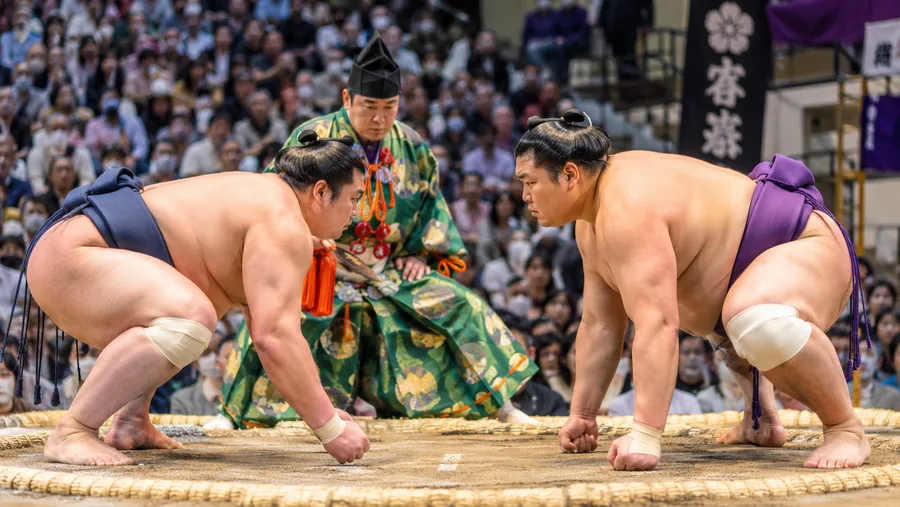
Inside the ring stands the gyoji, the referee dressed in ornate silk robes modeled after the court attire of the Muromachi period. He carries a wooden war fan (gunbai) that he uses to direct the wrestlers and signal the victor at the end of the bout. The gyoji shouts rhythmic encouragements throughout the clash, yelling "Nokotta! Nokotta!" (You're still in it! Stay in!) while the men grapple along the edge.
The referee does not have the final say. Seated around the base of the mound are five shimpan - ringside judges dressed in black formal kimonos. These judges are retired wrestlers who watch the action from eye level. If a finish is too close to call, or if a judge believes the referee pointed his fan the wrong direction, any one of them can raise a hand to call a mono-ii (a discussion).
The five judges step onto the dohyo and huddle in the center while reviewing slow-motion video feeds transmitted to them by a booth crew in the back rooms. It feels remarkably similar to modern football reviews, except it happens on sacred clay while thousands of fans wait in dead silence. They can uphold the call, overturn the referee, or order a torinaoshi - an immediate rematch if both wrestlers hit the dirt at the exact same millisecond.
If you are planning to attend an official tournament in Tokyo, Osaka, Nagoya, or Fukuoka, keeping track of these judicial huddles adds an extra layer of tension. Checking the official Japan tournament schedule and ticket guide helps secure balcony seats on days when top-tier rivalries take place, as that is when controversial finishes occur most often.
- Mono-ii conferences: occur roughly once or twice per day, giving spectators a tense glimpse into ringside debate.
- Torinaoshi rematches: require exhausted wrestlers to reset their belts, take their stances, and charge all over again within three minutes.
- Dead body rule: known as shini-tai, this rule states that a wrestler who is already completely airborne and doomed to fall may legally lose even if his opponent's hand touched the clay a fraction of a second earlier.
Frequently Asked Questions about rules of sumo wrestling
What are the rules for sumo wrestling when both wrestlers fall out together?
The judges apply the shini-tai ("dead body") principle. If one wrestler was driven completely off balance and had zero chance of recovery, he is considered defeated even if the attacker's hand or foot touched the ground slightly before the falling wrestler landed. If it is genuinely too close to separate, the judges order a complete rematch called a torinaoshi.
What is the goal of sumo wrestling during a professional match?
The goal is simply to force any part of your opponent's body other than the soles of his feet to contact the ground, or to push him completely outside the circular straw boundary. Accomplishing either condition ends the match instantly in your favor.
Are there weight classes in sumo professional tournaments?
No. Japanese professional sumo (Ozumo) is entirely openweight. Lighter rikishi must compete directly against giants weighing upwards of 400 pounds. Weight categories only exist in international amateur leagues and the world sumo championship.
What happens if a wrestler pulls his opponent's hair?
Pulling the mage topknot is an illegal move called a kinjite. If a judge or referee catches a wrestler grabbing hair to gain leverage or execute a throw, that wrestler is immediately disqualified and the victory goes to his opponent.
Quick Reference
- Ring diameter: 4.55 meters
- Weight limits: None in Ozumo
- Bout length: Usually 5 to 15 seconds
- Tournaments: 6 per year, 15 days each
- Winning record: 8 wins (kachi-koshi)
Book your sumo wrestling kyoto experience:
The Bottom Line
On paper, sumo seems like the simplest combat sport ever created. Two massive athletes step into a sand circle and shove each other until someone falls down. Once you spend an afternoon watching the footwork, the frantic grips on the belt, and the high-stakes calls made by ringside judges, you see the brilliant tactical depth underneath the simplicity. If you ever have the chance to grab a seat at a grand tournament in Japan, do it without hesitation. Just remember to watch the feet along the straw rope, because that is where the real drama unfolds.
Read more about sumo wrestling kyoto.